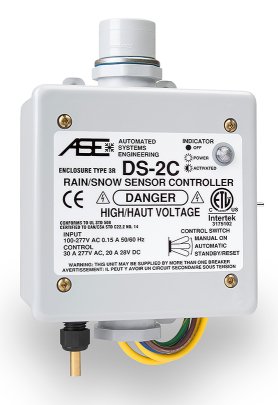
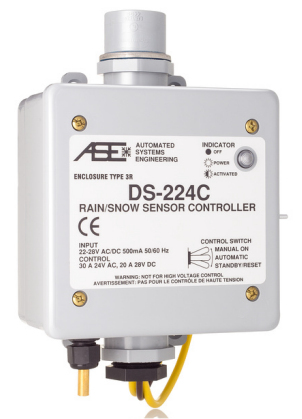
| Overview of the DS Series |
 The ASE DS
series of sensors and controllers provide a balance between
price, sophistication, and control capabilities and capacities.
Each unit is housed
in a sturdy NEMA 3R enclosure rated for outdoor use. All internal
electronic components are spec'ed for -40oC to +85oC
operation. All line voltage units are ETL UL Standard 508/CSA C22.2
No. 14 Listed and European CE EMC
directives have been achieved, opening the door for both domestic and overseas use.
The ASE DS
series of sensors and controllers provide a balance between
price, sophistication, and control capabilities and capacities.
Each unit is housed
in a sturdy NEMA 3R enclosure rated for outdoor use. All internal
electronic components are spec'ed for -40oC to +85oC
operation. All line voltage units are ETL UL Standard 508/CSA C22.2
No. 14 Listed and European CE EMC
directives have been achieved, opening the door for both domestic and overseas use.
If you are tired of
throwing old sensors away with no possibility of repair, take a
look at the DS series. Unlike "p otted"
sensors and controllers, every DS unit offers
full access to the sensor electronics. This unique design
allows configuring and adjusting the unit for most efficient operation. The
precipitation sensor may also be replaced in the field. Why replace the whole
controller
when an inexpensive precipitation sensor may restore your system to
"like new" performance?
otted"
sensors and controllers, every DS unit offers
full access to the sensor electronics. This unique design
allows configuring and adjusting the unit for most efficient operation. The
precipitation sensor may also be replaced in the field. Why replace the whole
controller
when an inexpensive precipitation sensor may restore your system to
"like new" performance?
Tired of stocking 10 different part numbers for the same basic sensor? At ASE, we exploit our microcontroller design to the fullest. Every line voltage DS unit can accept and control any input supply from 100VAC to 277VAC. And low voltage companions for the DS-2C (DS-224C) and DS-8C (DS-824C) are available for hydronic and other low voltage systems. All options and adjustments for each unit are field selectable. This allows covering all of your requirements while keeping your stock low and lead times short. Pigtail cable color codes conform to international standards and all units now ship with a 3/4" base conduit hub and a 3/4"-to-1/2" threaded reducing bushings. One sensor = one part number. Standardization means fewer variants, lower costs, and less inventory requirements for you.
| Basic Theory of Operation |
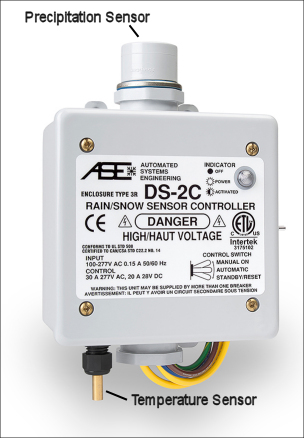 All DS units operate by
detecting environmental conditions through a base mounted temperature sensor and
a heated precipitation sensor. When rain or snow land on the precipitation sensor
the traces are bridged and a closure is detected. The heater then
rapidly evaporates the moisture, clearing the sensor. The sensor
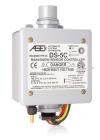
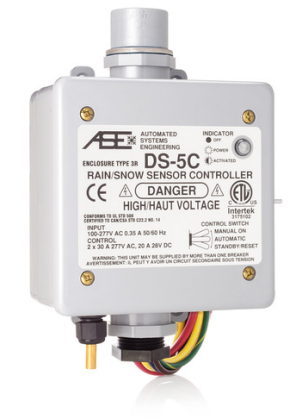
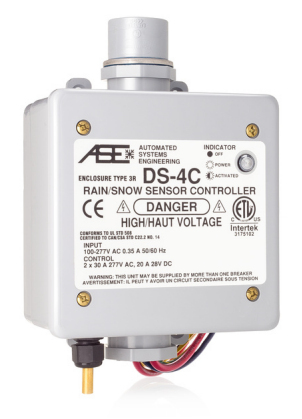
for the DS-2C, DS-224C, DS-4C, and DS-5C
simply
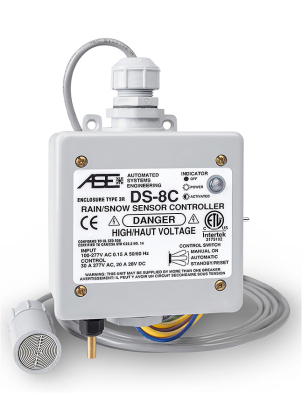
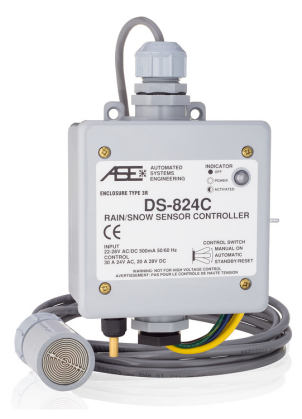
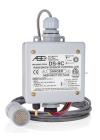
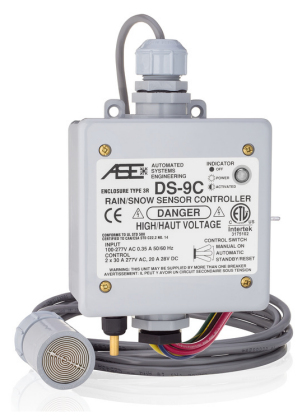
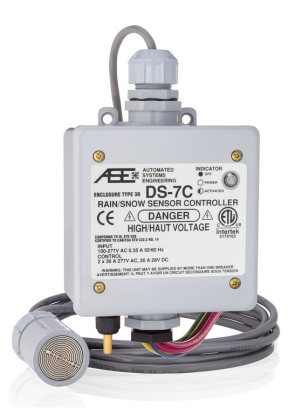
screws into the top of the controller enclosure. The DS-7C, DS-8C, DS-9C, and DS-824C
precipitation sensors
are connected to a 10 foot cable and are intended for remote mounting, either on a
feed boom for satellite antenna deicing or in a gutter or downspout for roof
deicing.
All DS units operate by
detecting environmental conditions through a base mounted temperature sensor and
a heated precipitation sensor. When rain or snow land on the precipitation sensor
the traces are bridged and a closure is detected. The heater then
rapidly evaporates the moisture, clearing the sensor. The sensor
for the DS-2C, DS-224C, DS-4C, and DS-5C
simply
screws into the top of the controller enclosure. The DS-7C, DS-8C, DS-9C, and DS-824C
precipitation sensors
are connected to a 10 foot cable and are intended for remote mounting, either on a
feed boom for satellite antenna deicing or in a gutter or downspout for roof
deicing.
These signals are then supplied to the microcontroller. Depending on the way the user has configured the sensor the microcontroller determines the appropriate action to perform. For example, the DS-4C contains two control relays. Using the profile selection switch (see the DS-4C page for more information) the controller can close one relay for low temperature detection and the other for precipitation detection. It can also be configured to close one relay when rain is detected and the other when snow is detected. It can also close both relays only when snow is detected, allowing control of larger loads.
The difference between "sensor" and "controller" modes is the "Delay Off" drying cycle provided by each configuration. "Delay Off" time is the amount of time the sensor/controller will hold the load control relay(s) closed after the last detection of rain or snow. Proper setting of "Delay Off" assures that pavement or roofs not only melt but also dry, reducing the chance for dangerous refreezing of water left behind. A sensor is used to activate an external control unit when rain or snow is occurring. The external control unit activates and operates the deicing system as required. A controller is expected to not only detect snow or rain conditions but to also directly control the attached equipment. A DS series unit set as a controller provides a longer delay off time, typically 30-90 minutes or 2-6 hours, allowing the heating system to dry the surface and prevent refreezing.
All DS units provide a remote "control/monitor" interface, a point where ASE or customer supplied devices can be connected to remotely monitor activation of the system and/or manually activate or disable the controller. Some units also feature a built-in switch to perform these same control functions directly from the sensor. The rack-mounted DP-7B or wall-mounted CDP-2 Remote Control/Status Panels may be directly connected to any DS series sensor/controller in order to provide both remote control and monitoring of DS sensor/controller operation.
| Common Features List: |
 Reliable Rain and/or Snow Detection
Can Also
Function as a High Power Intelligent Thermostat
Line
Voltage Units:
Supply -
Universal 100-277V AC 50/60 Hz Operation, No Strapping Required
Control - Full 30A @ 277V AC, 20A @ 28V DC
Low
Voltage Units:
Supply - 22-28V
AC/DC, 15VA Max
Control - Full
30A @ 24V AC, 20A @ 28V DC
Inexpensive,
Replaceable Precipitation Sensor
Easy Installation, Full Access to Electronics
10 Different Functions, 1 Part Number, Simplified Ordering
Standard 3/4" NPT Conduit Hub, Includes 3/4" to 1/2" Reducer
Adjustable Temperature Trigger Point
Adjustable Delay Off Drying Timer with 30-90 Min or 2-6 Hr Ranges
Adjustable Precipitation Sensitivity
Super Bright Power/Activation LED Indicator
Simple
Remote Control/Monitor Capability
Selectable Low Temperature Cutoff With Unique "Recover" Mode
External
Manual On-Automatic-Standby Override Switch (Except DS-4C/DS-7C)
Smart "Manual On" Operates for One Delay Off Cycle
Remote Control/Monitor Devices Are Available (See
Accessories)
| MODEL | DS-2C | DS-224C | DS-8C | DS-824C | DS-5C | DS-9C | DS-4C | DS-7C |
|
|
|
|
|
|
|
|
|
| Precipitation Sensor | Integral | Integral | Remote (10' Cable) | Remote (10' Cable) | Integral | Remote (10' Cable) | Integral | Remote (10' Cable) |
| Input Power | 100-277V AC | 22-28V AC/DC | 100-277V AC | 22-28V AC/DC | 100-277V AC | 100-277V AC | 100-277V AC | 100-277V AC |
| Control: AC | 1 x 30A @ 277V AC | 1 x 30A @ 24V AC | 1 x 30A @ 277V AC | 1 x 30A @ 24V AC | 2 x 30A @ 277V AC | 2 x 30A @ 277V AC | 2 x 30A @ 277V AC | 2 x 30A @ 277V AC |
| Control: DC | 1 x 20A @ 28V DC | 1 x 20A @ 28V DC | 1 x 20A @ 28V DC | 1 x 20A @ 28V DC | 2 x 20A @ 28V DC | 2 x 20A @ 28V DC | 2 x 20A @ 28V DC | 2 x 20A @ 28V DC |
| O&M Manual |
 |
|
|
|
|
|
|
|
| Preferred For: | Lowest Cost | Low Voltage | Remote Sensor | Low Voltage | High Capacity | High Capacity | Antenna Optimized | Antenna Optimized |
| Pavement Snowmelt |  |
|
|
|||||
| Hydronic Snowmelt | |
|
||||||
| Roof & Gutter Deice | |
|
|
|||||
| Rail Switch Deice | |
|
|
|||||
| Sat Antenna Deice | |
|
|
|
||||
| Sat Antenna Rain Div | |
|
|
|
||||
| Sat Deice & Rain Div | |
|
||||||
| VSAT Deice | |
|
||||||
| Tower Deice | |
|
|
|
||||
| Observatory Shutter | |
|
|
|
||||
| Low Voltage Control | |
|
||||||
| Building Automation | |
|
|
|
|
|
||
| Skylight Control | |
|
|
|
||||
| Irrigation Sensing | |
|
|
|
||||
| Operating Modes: | * | * | ||||||
| Snow Sensor | |
|
|
|
|
|
||
| Snow Controller | |
|
|
|
|
|
||
| Rain Sensor | |
|
|
|
|
|
||
| Rain Controller | |
|
|
|
|
|
||
| Precipitation Sensor | |
|
|
|
|
|
||
| Precipitation Controller | |
|
|
|
|
|
||
| Low Temp Thermostat | |
|
|
|
|
|
* Reference installation manual for DS-4C/DS-7C unique operating modes
Looking for Remote Control & Monitoring, Cabling, and
Other Components?
Take a Look at DS Series Accessories
Inexpensive, Off-The-Shelf Ground Fault
Protection Meets NEC and CEC Requirements
Consider the
GF Ground Fault Protection Unit

For More Information, Contact
Automated Systems
Engineering, Inc.
2833 N El Paso Street
Colorado Springs, Colorado, USA 80907
Phone: 719-599-7477
 info@goase.com
We accept all major credit cards!


Home
DS Sensors GFPE DP-7B
CDP-2 EX-50
Cable
Sets Parts
Manuals Troubleshooting
Best if viewed at 1024 x 768 or higher
This site is copyright 1998-2022 by Automated Systems Engineering, Inc.
Comments about the website? Please contact webmaster@goase.com
Last Update: 06/13/22


![[Home]](images/homebut.gif)
![[Sensors]](images/senbut.gif)
![[Ground Fault]](images/gfbut.gif)
![[Accessories]](images/accbut.gif)
![[Support]](images/supbut.gif)
![[Contact]](images/conbut.gif)